
RELATIONSHIPS Archives - Page 8 of 24 - Love TV

Who is Using Who for Sex?

We’ve all been there, or known someone who has.


Why do smart, compassionate, beautiful women find themselves pining after emotionally unavailable men?

For a while, I was the one my girlfriends always went to when they needed to vent about that one guy who never called them back. I’ve been texted at all hours with excited declarations like “he wants me to come over to watch a movie. It’s 2 am, but still!” And then, there’s the inevitable anguish when “he” doesn’t want a relationship. 

I’ve heard all the stories. I know all the details. Year after year, it’s the same. And it’s heartbreaking. I know too many women who are being used for sex – and none of them are willing to admit it, until it’s too late.

It’s been said to ‘never take advice from some you wouldn’t want to trade places with.’ I’m not an expert, by any means. I am not some magical relationship fairy, who’s never made a bad decision. I have been in this situation myself, but it took me years after the fact to finally look back and admit it. If you want advice on learning how to see through manipulation before it’s too late, read on. The tips I’m about to share with you came from years of my own mistakes, and from watching my friends fall into the same traps year after year.

If a woman is looking for a relationship, why would anyone think it’s okay to manipulate her? Why do one-sided relationships drag on for months and months, until someone’s self-worth has been suffocated? 

The honest answer: We may walk into these bad situations on accident, but we stay there on purpose.

Look, we live in the 21st Century. Mutual, no-strings attached, casual intercourse is totally okay. It’s also just fine for two people to start out on the same page, and change their minds later. You are entitled to end a relationship how and when you wish, and so is he. Everyone has the right to choose. But it is wrong to make the conscious decision to manipulate, coerce, or string someone along just for sex.

Men are not the only guilty parties here. Women use men for sex, as well. But for the purposes of this article, I’m taking aim at the most common scenario. Whether you are male or female, it is important to protect your heart and recognize your needs. Here’s how.

  1. Ask yourself: What are my needs?

    An emotionally healthy relationship requires having conversations that don’t always lead to sex. It requires two people who are there for each other, whether sex is a factor or not. Do you wish he’d take you out on dates? Are you hoping he’ll introduce you to his friends and family? Would you be happier if he shared more with you than just his body? All of us have needs, and you should take the time to define them for yourself.

  2. Make your needs clear before sex is even brought up in conversation.

    Millennials live in a social media-driven culture where we almost “compete” to see who is less attached and more “chill.” I’d go into the reasons behind this, but that’s a topic for another day. My point here is this: Once upon a time, it was completely normal to say “I’m interested in a relationship with you, and would love to take you out on a date.” Now, the boundaries between friendship, casual sex, and dating are a lot less clear. While it’s totally fine to want a casual relationship for sex, it’s not okay to pursue one with someone who wants more than that. If you’ve been burned in the past, recognize that every day is a new opportunity to change the pattern. You’re the captain of your own ship. Your well-being should not be left up to another person. Avoiding manipulation requires YOU making your intentions clear from the start.

  3. Recognize red flags.

    If he’s always unavailable on weekends, but he’ll call you at 11 pm on a Wednesday night to “hang out,” that’s a red flag. If you’ve made it clear you want a relationship, but he keeps ignoring the issue, that’s a red flag. If you’ve never meet his friends (or you’re introduced as merely his ‘friend’ if you do), that’s a red flag. If he goes days without answering your texts (unless it’s to set up a cozy Netflix and chill session), that’s a red flag. If he tells you that he’s not looking for anything serious…that’s THE sign it’s not happening.

…Do you see where I’m going with this?

  1. Be honest with yourself.

    All too often, we diminish our feelings to suit the person we’re hoping to impress. I know it can be difficult to assess the situation amid the endless butterflies and infatuated thoughts. But if you really examine the situation, it’s often pretty obvious when a guy is not down for commitment.

  2. The only person you can change is you. 

    At this point, you may be thinking, “I’ll be the one to change his mind!” But I am here to tell you that it doesn’t work that way. If he changes his mind for you, it won’t be because you let him sleep with you, allowed him to repeatedly ignore you, and pretended that you don’t have needs. You deserve love and respect. And this requires loving and respecting yourself. If you want a relationship, and it’s clear that he doesn’t… your friend should find a new sex buddy and you should look for commitment elsewhere.

So – are you setting yourself up for heartbreak? Most of us already have the answers, we’re just too afraid to see them. No amount of calling your girlfriends, reading advice articles, or scrolling through his Instagram will give you the validation you need. You deserve to be honest with yourself, and to find a partner who is honest, too.
How Do I Continue to Not Screw Up this Relationship

Losing Control

On a deeper level, (and not to take away from collaborative grocery shopping experiences, which are very important) being in a relationship means losing control. I don’t know what’s going to happen to us. I can’t control every situation. That loss of sovereignty is terrifying, and why it’s always been easier to dive into something new rather than stay in something that I can’t totally steer and becoming *gasp* vulnerable to this person, another issue of mine that we’ll have to get to during another session thank-you-that’s-all-the-time-we-have-for-today.

Tasting What He Orders

Which brings me to another food metaphor.

On Saturday, my boyfriend and I were eating together, because we’re in a couple and that’s 90% of what you do together besides making passionate love and scrolling through Netflix.

I’ve noticed something about these meal times. Almost as a rule, I want to try his food. It doesn’t matter if it’s a plain salad or contains an ingredient I don’t particularly care for, I want to try it, and he lets me, because he’s a nice guy. But rarely does he want to try mine.

I brought this up.

“Why don’t you ever want to try my food?”

To which he replied, “I’m happy with what I ordered.”

“Oh my God.” I said, as it hit me. “That’s the difference between you and me. You’re satisfied with your choice, and I always want what the other person is having.”

“Your words, not mine.”

Look, I don’t want to insert too much meaning into this, because it’s possible I’m just a glutton (definitely true), but it’s hard not to attach some meaning, because it hits on A) a problem we’re facing in the modern dating landscape, and B) a character flaw of mine not unlike the ‘grass is always greener’ metaphor, another one we’ll have put a pin in because thank-you-that’s-all-the-time-we-have-for-today.

Here’s How a Happy Marriage Can Be Simpler Than You Think

According to a new study published in the journal Personal Relationships, the key to improving a marriage is to show a little gratitude.


It seems like every other day, another study comes out promising to give us the key to a successful marriage. Why not? After all, those of us who want to be married want to stay married. In fact, a 2011 Pew Research survey found that 36 percent of adults believe that having a successful marriage is “one of the most important things” in life. While I don’t really believe that relationship success is dependent on one major “key,” and that it’s more of the right combination of the little things, a new study shows saying two small words can actually strengthen your marriage. Ready for them?

“Thank you.”

According to a new study published in the journal Personal Relationships, the key to improving a marriage is to show a little gratitude. Researchers from the University of Georgia conducted a telephone survey of 468 married individuals and asked them questions about their finances, their communication tactics, and how they express gratitude to their spouses. As the study found, expressions of spousal gratitude were a significant predictor of marital quality.

“It goes to show the power of ‘thank you,’” said Allen Barton, a postdoctoral research associate at UGA’s Center for Family Research and lead author of the study. “Even if a couple is experiencing distress and difficulty in other areas, gratitude in the relationship can help promote positive marital outcomes.”

The study also found that couples who showed higher levels of spousal gratitude were less prone to seek divorce. When couples express gratitude or show appreciation for each other, it can counteract or buffer the negative effects of conflicts. According to researchers, feeling appreciated and believing that your partner values you have a great impact on how you feel about your marriage and your commitment to making it last.

“All couples have disagreements and argue,” the study’s co-author Ted Futris said. “What distinguishes the marriages that last from those that don’t is not how often they argue, but how they argue and how they treat each other on a daily basis.”

In short, it’s the little things that matter.

Saying those two small words can do your relationship a bunch of good. But sometimes, expressing gratitude can go beyond a simple “Thank you.” Because of that, I talked to Dr. Ramani Durvasula, a licensed clinical psychologist and author of Should I Stay or Should I Go: Surviving a Relationship With a Narcissist, on how you can express gratitude to your partner each and every day.

1. Reach Out

Set aside time each day to reach out to your partner and listen to them talk about their day. As Dr. Ramani tells Bustle, “They may not be able to respond, but it becomes a touchstone, and lets them feel heard.”

2. Take Initiative

“Do something for them that they do not like to do without asking,” Dr. Ramani says. “But do it without making lots of noise about it. For example, take the car in for an oil change, clean the toilets, or weed the garden.”

3. Surprise Them

“This does not need to be big. It can be dinner on the table, making the plans and just whisking them away to something you know they like. Even try giving them a small gift that shows up in a briefcase at work,” Dr. Ramani says.

4. Compliment Them

“I know it seems small, and likely should be happening every day. But we often forget that those little words about your partner’s work, a new dress, or their smile put a swing in our step when we get them from strangers,” Dr. Ramani says. “But they can be profoundly impactful from our partners.”

5. Ask About Stuff

Don’t just listen, but engage in conversation. If your partner tells you something that happened at work, ask a follow up question the next day (i.e. “Whatever happened with that guy at work you told me about yesterday?”).

As Dr. Ramani says, “It shows not only that you were listening initially but that it is sustained. Few of us are heard any more in such a distracted world. To hear someone listening to us is a fantastic way to show gratitude.”

6. Again, The Little Things Count

Don’t be afraid to say “Thank you” or “I’m grateful” or “I noticed what you did.” According to Dr. Ramani, while those words are simple enough, they show that we notice the effort that our partner puts into the relationship and that we’re grateful for them.


Curated by Erbe
Original Article

The Art of Compromise in a World of Me

Decisions That Make or Break the Relationship

I recently just saw a 10-year relationship fall apart. The wife decided to do her own thing for a bit and took a job that required her to be away from her husband for 6 months. Naturally, she had an affair. Boom. 10 years of marriage. Over. Is the affair to blame or is it the decision to leave your partner for 6 months? 6 months is a long time to be away from your partner, for that reason many busy couples have the two week rule, they won’t go more than two weeks apart. Anything over that can feel like a break up, and when you see one another again it can be cumbersome and difficult to reconnect.

Whenever you make any decision in a relationship you must first think of what effect it can have on A, your partner, and B, the relationship. Sleeping in different rooms, being apart from one another for reasons other than survival, even having separate lives i.e. different friends, can all take a toll. Marriage is about SHARING your life with someone, not living independently within a relationship, that’s called being roommates. So before you consider investing in a “Sleep Number,” think about what’s more important to you, sleep itself, or someone to sleep next to.

Women Share How Their Intuition About Cheating Turned Out

In a technology-filled world, the temptation to read your man’s Facebook messages or snoop through his texts his overwhelming. But are you in the right to do so?


When Emily Gold* logged onto her husband’s email with dread pooling in stomach, she was hoping for the best. Instead, she was met with a rude awakening: clear cut evidence of her husband’s affair scattered throughout his emails. Love notes, song lyrics, photos of the two of them together, but that wasn’t all. The worst was a pro/con list, written by her husband, on whether or not he should leave her. “It was the worst thing I have ever seen with my eyes,” Gold said.

She’s not alone: according to a 2011 study, 41-percent of women have snooped through their man’s phone or emails. Modern technology offers a whole new variety of ways to spy on your partner. Looking through drawers and checking for lipstick on the collar is a thing of the past. According to a January 2013 poll by the Daily Mail, going through your partner’s cell phone is now the top reason why cheating and affairs are exposed.

But why do we snoop? When Hannah Rolf’s* boyfriend left his cell phone at her house, the temptation was too much to resist. “Of course what girl would not wanna look at everything that was on there?” she told MC. Of course, giving into temptation can have some drastic consequences. When Rolf was reading through his phone one night while they were in bed, she saw that he had been texting quite a few other girls, which led her to end the relationship. All this sneaking around raises a big question: Is it wrong to read your man’s texts or emails if you end up learning he’s been hiding things from you, or does snooping bring you down to his level?

Snooping may be a breach of trust, but it can also expose some untrustworthy behavior. The most common of this is evidence of cheating. Steamy emails, declarations of love, notifications from dating sites, and worse. Jessica Lee* found naked photos of other women when reading through her boyfriend’s text messages.

Sometimes, you just have a sixth sense, a feeling that something is up. When your senses are tingling and a phone is ready for snatching, controlling the urge to snoop isn’t easy. Such was the case for Allison Brady*, who became wary of her boyfriend’s relationship with his ex. After hearing him refuse to say her name and bitterly reminisce about their time together, she knew he wasn’t quite over her yet. When he started mentioning her more-and-more, warning signs went off. Brady’s snooping started innocently enough: looking through his Facebook to see if he had added her again. As her lurking continued, she discovered that they had been talking again and were planning on meeting up for coffee. She broke up with him soon after.

While her snooping was instrumental in the demise of her relationship, Brady feels that snooping is sometimes necessary to find out the information you deserve. “I would snoop again only if I felt something was off,” she said. “Otherwise, I understand boundaries. I’m not that interested in what my boyfriend talks about with his friends.”

It’s not always infidelity that women catch when they snoop around. Sometimes, you learn that they’ve been doing the same thing to you. When Lindsay Young’s* boyfriend gave her his email password, she started reading his emails. The snooping didn’t end there: When he borrowed her laptop and forgot to logout, she was able to search through his Facebook, as well. She discovered that he had subscribed to her check-ins in order to receive notifications about her whereabouts. Young stressed the fact that if you’re going to snoop, you need to prepare yourself for what you may find. “I guess when you’re looking for something, you’ll find it,” Young said.

When women find incriminating information through snooping, as you might expect, they oftentimes won’t stand for it, and they act out. Such was the case for Donna Crane*. Crane had a bad feeling about the man she had been seeing. One night after he had fallen asleep, she grabbed his phone and quickly scrolled through his text messages. Turns out her intuition had been right—there were texts from three different women in his inbox.

Instead of confronting him, she quickly wrote back to the other women in his phone, telling them that he was ending it with them, and he was getting serious with another girl. She then proceeded to delete all of his contacts—her own number included. Maybe it’s true what they say—hell hath no fury like a woman scorned.

But perhaps the best way to satisfy your curiosity is simply to ask. Men with nothing to hide may be more willing to share the contents of their phone or email with you. “The easiest way to find out if your boyfriend is hiding something is to simply ask him if you can look through his phone and if he says no, well then there’s your answer,” Rolf said.


Curated by Erbe
Original Article

How to Move On from Your Ex in Social Media and Elsewhere

Delete his number from your phone.

You know that each time that you pass his past texts in your inbox, you’ll feel the heartbreak all over again. So, why put yourself through that angst? Delete his number from your phone and don’t give it a second thought. This will stop you from being tempted to draft a text to him in your phone or worse–drunk text him over the weekend. You may think you have self-control, but it’s better to be safe than sorry, right?

Penn State University collegiette Rachel Lytle puts it bluntly: “Just literally stop any form of communication altogether. No Facebook, no Skype, no texting or phone calls. Nothing for a few months. You’re left with no choice but to move forward!”

For Erin, a student at Emerson College, breaking up with her boyfriend of two years was made easier by removing all reminders of him.

“At first it was difficult because I was so crushed by the break-up,” Erin says. “Eventually, I knew I had to quit torturing and ‘testing’ myself to see how I was doing. I blocked my ex on Facebook, made a separate file in my computer for old photos of us, put reminders of him in a box under my bed and deleted his number from my phone. I didn’t have the heart to throw all my memories away but I needed it all out of sight to help my heart heal.”

Scarborough says to take it a step further, “Make sure you clean out your voicemails. And while you’re at it, make it a clean sweep. Get rid of any old emails from him and purge your texts.

This may seem harsh, but you need to start creating your own life without your ex in it. The sooner you create a clean slate for yourself, the better. You’ve got a whole new life to start living!”

Avoid running into him, whether you mean to or not.

Admittedly, it can be hard not to run into your ex on a small college campus and you can’t help it if you happen to enroll in the same marketing class (ouch), but avoiding the places you used to go as a couple can help you get over him faster. Whether it’s that café where you always met for a cup of coffee or that theater where you met for movie dates every Thursday, those are the spots to avoid.

“You should stop making excuses to walk by his favorite bar ‘just to see’ if he’s there,” says Kate Miller from the University of San Francisco. “My roommate did that all the time when she broke up with her boyfriend and it just made things harder for her. I’m sure running into him all the time didn’t help.”

If you have a mutual friend, ask about when your ex will be at certain places so you can avoid going there around that time. Try not to overdo this, though—constantly planning your life around him could make it hard to forget him. If you go to the same fitness center, switch up your routine by going for a run around the neighborhood instead of doing the elliptical at the gym. If you’re trying to get over him, seeing him everywhere only makes you hurt more. You can take this opportunity to find new hangout spots and make new circles of friends.

Relationship Resolutions — Why They Are So Important to Your Happiness

“Our network of 140 local Minds across England and Wales provide a range of services, many of which centre around enabling social participation, such as befriending. For people who feel less comfortable talking face-to-face, online peer support networks can also be incredibly helpful,” he adds, highlighting Mind’s online community Elefriends which offers a space for people to discuss their problems with others facing similar issues.

Luke Tyburski, an endurance adventurer, from London, says that he gained the strength to deal with and speak openly about his struggle with depression thanks to his friends and family.

The 33-year-old argues that social media can be a source of insecurities, as we watch seemingly perfect lives unfold online. But the reality can be starkly different, he says. “As an endurance adventurer, my life online, and in the flesh, may look and sound amazingly perfect to many. But after suffering in silence for nearly a decade, it’s only been over the past 12 months that I have felt the courage and strength to speak openly about the darker side of my life, and the battle I constantly have with depression.”

“One particular friendship has been quite unique, and helped me not only get through some difficult times, but has also encouraged me to enjoy life as well. Darrell and I have been mates for years now, he is someone who I’ve spent plenty of time laughing, joking, and chatting with.

“Darrell was simply there for me, not 24/7, or everyday even, but I knew that if I did need him, I could call to just chat about life, laugh at our own jokes, or enjoy a coffee together in each other’s presence.”

But while relationships can be a source of strength, they can also be extremely damaging if a person is manipulated and made to feel trapped. “Healthy relationships are extremely important for one’s well-being both physically and emotionally,“ says Dr Natasha Bijlani, consultant psychiatrist at the Priory Hospital in the suburban London area of Roehampton. “Such relationships help validate one’s sense of self, self-esteem and self-confidence.”

“In my opinion, the commonest way in which a person’s mental health can be damaged by a relationship is by intimidation, bullying and coercion,” she says. Such pressures can lead to physical disorders as extreme as heart disease, and trigger psychological disorders including depression and addiction.

Dr Bijlani adds: “In many cases exposure to such behaviour can lead to chronic problems in trusting others and forming healthier relationships in the future. It is often the case that the closer the bond, the worse the damage, she says.

Keeping Things From Your Ex. Good or Not?

They threw everything out. This group preferred to pitch everything, regardless of whether they ended the relationship, or were sad about the ending. They wanted to disconnect, compartmentalize and put the past behind them. One man called it the “get rid of it all and move on” technique.

They got rid of everything but engaged in a cleansing ritual by dramatically discarding a few items. This group acted out their pain by engaging in a behavior that felt empowering. This strategy was highly correlated to feeling “used/betrayed/abused/ manipulated” in the relationship. People often chose to engage in an experience that purged the negative break-up energy. Some of the women described lighting fires, cutting things up, dropping items off cliffs and buildings, and burning objects and spreading the ashes.

Endings are complicated. It is difficult to deal with why something that once felt so good went south. But when you are faced with this circumstance, you will figure out what is the best way to handle all the mementos that you accumulated during the relationship and decide whether you want to do a box run to a packing company, give your local Goodwill donation center a visit, or create a bonfire and torch a few things. As long as your destruction is reserved solely for inanimate objects and won’t cause any physical harm, you’ve got nothing to worry about.


Curated by Erbe
Original Article

Relationship Types You Can Find Yourself In

Before you find “the one,” you’ll date a bunch of other ones. Only the truly lucky find a great relationship—built on compatibility, mutual respect, and sexual attraction—early on.


Most of us have to have all the other types of relationships, to understand what a functional relationship should look like.

Here are 14 types of relationships you will almost certainly have before you find long-term happiness.

CODEPENDENT

In this relationship, you or your partner (or both of you) cannot function without the other person. You feel anxiety and depression when you’re not around one another. Other areas of your life suffer. You’ll often do out of the ordinary things to keep this person’s love—like cancel a trip you planned years ago with friends, to stay with this person, or give up a great job to have more time with your partner.

INDEPENDENT

You’re a “power couple.” Or at least, you think you are. What you really are is this: two people who do not know how or are not willing to compromise and sacrifice for the relationship. You always put yourself ahead of your partner, and visa versa. You’re both highly focused on your careers, or your own separate social lives. You essentially just meet up when it’s convenient for both of you. But love is not a priority.

DOMINATING

At one point, unfortunately, you’ll date someone who controls you. He will set all the rules for the relationship, and you will follow them. Something about this person makes you spineless. You don’t even see how ridiculous his rules are, such as a rule that you not go out with friends without him, or that you stop talking to your male friends, or that all holidays are spent with his family instead of yours. You’ll be under a spell that will be clear to your friends, but for some reason not to you. And you’ll feel great anxiety around ever speaking your mind or demanding something from this person.

REBOUND

You, and possibly the other person involved in this relationship, have just gone through breakups and need love to cover up the pain. This relationship almost never works out because it is built on the fear of facing the reality of your recent breakup, rather than focusing on this new person and whether or not they are compatible for you. So it is fragile.

OPEN

We all get a little new age at some point and give this relationship a try. In this relationship, the two individuals are emotionally committed to one another, but are both free to sleep with other people. This type of relationship mostly only works when both parties aren’t that emotionally invested in one another. And for this reason, it usually ends anyways.

WORKING HARD

You really want love, you meet someone who really wants love, and so you’re willing to make a lot of changes for it. You change the way you talk, dress, think and socialize for him. He does the same for you. You actually have zero interest in one another’s passions and hobbies, but you attend all related event and feign interest. You look happy to the outside world, but it’s actually the most exhausting relationship you’ve ever been in.

TOXIC

Okay, the previous relationship is the second most exhausting relationship you’ll ever be in. This is the one that will leave you feeling emotionally, mentally and physically immobile. The toxic relationship is one in which you and your partner have an extreme attraction to one another, but have such drastically different morals, opinions, or integrity that all you do is fight. You bring out the worst in each other. But you can’t stay away from each other. You’re always on edge in this relationship. It’s like being on a drug: the highs are very high, but the lows leave you incapacitated.

TEMPORARY

It’s fun for now, but you wouldn’t make plans for the future. You couldn’t claim anything is wrong with the guy. You enjoy having sex with him and spending time with him. But that real umph isn’t there—that can’t live without him sensation. But it’s easy, and it’s a good distraction for a while.

BASICALLY FRIENDS

Everything is great except one thing: you and him do not feel like having sex with one another. It feels like kissing your cousin. You can have a fun day, connect on many levels, but when it comes to the bedroom, your blood runs cold.

PURELY SEXUAL

You’ll also have the opposite to the basically friends relationship: the purely sexual one. When you call or text one another, it’s almost always to spend time immediately. You’re mostly in the bedroom together. You have great sexual chemistry, and for some reason never feel compelled to explore your chemistry in other areas.

PRIZE POSSESSION

At one point you will date a rich or insanely handsome man, because you’re just intrigued by what life is like with that guy on your arm. You’ve seen gold diggers who seem happy with filthy rich gentlemen, or your giddy friend who is always with a model. So you give it a go. If you’re an emotionally sound person, you typically can’t carry this one on for long. You crave a real connection.

GOOD ON PAPER

You’ll date one guy because you should. Everybody—your friends, your family, complete strangers—think this guy is perfect. He’s handsome, he has a great job, he has a good sense of humor, he is kind, he is totally marriage and father material and he treats you like a queen. But again, the umph factor is missing. He doesn’t excite you. You can have great conversations, but a certain inexplicable connection just isn’t happening.

LONG DISTANCE

During one of your romantic phases, you’ll try out a long distance relationship. You’ll tell yourself yours will be the one to work out. And you’ll love going to visit him—it will feel like a vacation every time. But eventually, you’ll realize you don’t want to move to him, he doesn’t want to move to you, flights are getting expensive and you’re tired of missing out on what’s going on with your friends back at home.

EMOTIONAL AFFAIR

You probably will not realize it the first time you get into one of these, so we’ll give you a freebee. But at one point, you will develop an intimate, emotional connection with a man who is already in a committed relationship, or when you yourself are in a committed relationship. Nothing physical ever happens, but you share secrets with this person, you get anxious when you’re going to see him, and if you think about it, your or his partner wouldn’t really approve of it.


Curated by Erbe
Original Article

Up Level Your Relationship – Here’s How

I assumed there was something wrong with me for struggling in relationships, when it was actually my thinking that manifested everything that felt wrong.

I’m sure there are countless other people who’ve been in that place before: feeling isolated, disconnected, and confused about how to change it.

Others still experience something different but related: They have meaningful friendships, but still feel there’s something lacking—like there could be more love coming their way, romantically or otherwise.

I’ve learned a lot about giving and receiving love over these last several years, and I’ve dramatically transformed my thinking and sense of connection as a result. If you’ve ever wanted to feel more loved, you may find these tips helpful:

Open Your Heart

1. Initiate meaningful conversations.

The first step to feeling more loved is creating close relationships, and that starts with meaningful, engaged conversations. These don’t necessarily need to be deep and spiritual in nature. They just need to be honest, authentic, and reciprocal.

You can initiate this type of exchange with anyone at almost any time simply by asking about the other person, fully listening to what they have to say, and then finding common ground. Naturally some people will stay shut down, but it’s worth the risk of feeling vulnerable to find the ones who won’t.

2. Give the gift of your presence.

Often when we converse with people, we’re not fully listening; we’re formulating our response in our heads and waiting for our turn to talk. We’re not only doing the other person a disservice when we do this; we’re also shortchanging ourselves.

Think about the last time you really opened up to someone. It likely required you to feel a level of comfort and trust, even if you didn’t yet know that person very well. The act of opening up is itself an offering of love. It’s an invitation to let someone in.

In recognizing this and welcoming it by fully hearing other people, we are, in fact, receiving love.

Sharing Milk

Or perhaps the idea of another women breastfeeding your infant is a little scary to some, because the risk of passing along an existing disease, like HIV, is possible. Though the CDC has reported that the risks are extremely low, and having a mother with HIV breastfeeding your child is rare anyway. So is it the innate desire we all have protect our children from harm that invokes such strong reactions to this subject?

What about those women who choose to have their babies breast fed by others, not because it’s a medical necessity, but because they are simply too busy with their careers to be able to fully make the commitment to nursing, Maybe there are single mothers who can’t afford to take the time off of work providing for their baby, but still want all the healthful benefits? There are still wet nurses that are hired to breast feed other women’s babies so that these new babies don’t have to have formula. Are these women wrong for wanting to give their babies everything?

Breastfeeding your baby is very personal, with a lot of emotions attached at every turn. If you can breastfeed and produce enough milk to continue until the child is two, you are criticized. Or if you can’t produce enough milk and switch for an alternative form of food, like formula or obtaining another mothers breast milk, you are criticized. If breastfeeding is painful and you never get past it and you choose to have your child be on formula, you are criticized. This is one of those topics that strangers feel they can tell you how you’re “supposed” to do it while riding in an elevator to your office floor without even saying hello first. Which is why it’s no surprise that in our overly opinionated, hyper sensitive society with way more information at our fingertips than ever and the protection of a screen name, others feel that weighing in on such a topic without knowing anything about the individual is so normal.

Now I have to admit that even I have a knee jerk reaction when picturing another woman breastfeeding my almost 10 month old of “ewww”. When I search for why I feel that way, I can’t really pinpoint why. Was it the idea of another women feeding my child with her breast? Or the fact that she felt so comfortable and confident, she posted a picture of herself on the Internet actually doing it? Maybe it was the feeling that I would never be comfortable sharing my milk with another baby? I would like to think that of course I would help out another mother and baby in need, but am I strong enough to share my babies precious and ever dwindling milk? I’m still soul searching.

Breastfeeding is personal to every mother, so perhaps when Meg Nagle posted those pictures of herself breastfeeding her nephew on Facebook there was a feeling of her sharing something she shouldn’t have. Something private and sacred. But her intention, and result, was for her to raise the awareness about wet nursing, or “milk sharing” as it’s sometimes called. So no matter what your personal feelings on the subject, it was a powerful and effective way to get people talking, and hopefully learning about the

Here is Why Some Couples Never Cheat

Wondering how and why some couples never tend to cheat on each other? Here is the answer.


Perceptual downgrading of attractive persons who can turn out to be potential threats may help in sustaining relationships from temptation and keep couples from cheating on one another, finds a new study.

The findings showed that to keep up a steady relationship, couples are likely to use an unconscious ‘turn-off’ mechanism where either partner perceptually downgrades individuals who can act as possible threats to their relationships, as less attractive than they really are.

Couples who are highly satisfied with their current partners are more likely to use this mechanism.

“Committed individuals see other potential partners as less attractive than other people see them, especially if they see the attractive person as a threat to their relationship and even more so if they’re happy with their partner”, said lead author Shana Cole, Assistant Professor at Rutgers University in the US.

Both men and women indulge in this protective bias called ‘perceptual downgrading’ and which helps couples’ maintain their commitment to their current partners.

“When people encounter an enticing temptation, one way to reduce its motivational pull is to devalue the temptation”, Cole added in the paper published in the journal Personality and Social Psychology Bulletin.

“This study suggests that there are processes that may occur outside of conscious awareness to make it easier to stay committed to one’s partner”, she noted.

For the study, the team designed two studies. In the first study, the researchers told participants that they would be working with a very attractive person – who is either romantically unavailable or single.

They were shown the imaginary person’s face with its 10 morphed images and asked to pick the image that matched the original. The results shows that they consistently picked images morphed toward unattractiveness.

In the second study, the participants provided more information about their own romantic situations and the team described the imaginary person as single, and therefore, available.

Participants in relationships who thought the person was interested in dating found that person less attractive than individuals who were single.

People who were in relationships and were happy with their partners, perceived the imaginary person as less attractive than any other participant.


Curated by Erbe
Original Article

What to Do When You Want an Honorable Man and You Are With Someone that Keeps You In The Gray

With those boundary basics said, here are 3 boundaries I think every single woman should have…

1. Treat Your Sexuality Like a Queen.

What would your sex life look like if you were a Queen? Queens are precious to their community they rule with authority, control, and class. They govern their affairs wisely. They practice self control. They know they are beautiful and worth the wait. They don’t put up with lawbreakers, jackasses, and men who want to shirk their responsibility within their community.

Call me old-fashioned, but I think women need to build better boundaries in this area. Sex has become far too casual these days. Women actually have the power to inspire men to grow up and gain some self-control. But they’re not. And THEY NEED IT.

2. Don’t Stay in the Gray Forever.

You deserve to be dated. But you also deserve to be married (if you desire to be). If you’ve been hanging out in the “dating zone” far too long, make him “crap or get off the pot.” Enough stringing you along. Enough being “friends with benefits.” That’s just messing with your heart. And your heart needs to be guarded above all else. It’s your source of life. Start changing things up, by putting up a time boundary and see how he responds. “Boundaries in Dating” by Cloud and Townsend is a great resource to help you get started.

3. Use Your Honey to Attract Bees, Not Flies.

Law of attraction: Crazy attracts crazy. What are you “putting out” there and communicating to the world at large? Sure we should celebrate women’s beauty. But let’s redefine public beauty. It’s not boobs and ass. It’s character, face, story, and passions. A woman’s worth is not found in her outward appearance, but in her heart. Do your actions, words, and appearance reflect that truth? How do you dress around men? How do you act around men? What kind of words do you say around men? Use your honey to attract someone who you want coming around, not some fly who wants something for nothing.

What boundaries have you setup? Tell me in the comments below.


Curated by Erbe
Original Article

5 Tips for Non-Violent Communication to Use in Any Relationship, Inspired by John Cena

On July 4, John Cena reached the hearts of millions with a simple, yet powerful PSA called We Are America.

You can watch it here.


This video could not have come at a better time. Today, war is everywhere; racism is a deadly epidemic; homophobia is a danger…and the political climate is stormy, to say the least. Chances are, you will run into a great deal of heated conversations this week – both on social media and IRL.

“Non-Violent Communication” is a term you might hear thrown around in meditation classes or therapy sessions – but it’s much more than that. It’s a powerful tool that everyone can use.

  1. Consider the issue from all angles.

    In We Are America, Cena asks viewers to close their eyes and picture the “average” American. He doesn’t start out by telling us what we’re “supposed” to think; he simply asks for our point of view.

Aristotle once said, “It is the mark of an educated mind to be able to entertain a thought without accepting it.” You can listen to another person’s views without giving up your own. Keeping an open mind gives you a better chance of discovering what you have in common. This creates a foundation of trust.

Remember – the goal is ultimately for the other person to entertain your point of view, just as you’re entertaining theirs. If you offer yourself as an example of what peaceful communication looks like, they may be more likely to reciprocate.

  1. State your observations, facts first.

    After asking viewers to picture their “average” American, John Cena offers some rapid-fire facts about our country. “51 percent [of American citizens] are female,” he states. “So first off, the average American is a woman.” By offering hard data to support his position, Cena solidifies his perspective as true.

In personal conversations, using “I” statements and presenting undisputable facts are the most effective ways to communicate peacefully. For example: “I’ve noticed that you use a number of racial slurs from time to time,” is a lot less divisive than just saying “You’re a racist.”

Rather than labeling them outright (“racist”), present some facts and/or previous incidents (“racial slurs”) to support your position.

  1. Empathy is a superpower. Use it.

    By expressing your feelings about a certain subject, you’re initiating an emotional exchange. In the PSA, Cena argues against the wrong definition of “patriotism” that people use to justify hatred. But he doesn’t say “stop being bigots, America.” Instead, Cena offers empathy: if we really want to love our country (and he believes we do) then we ought to love the people in it – regardless of gender, orientation, religion or race.

“After all, what’s more American than freedom to celebrate the things that make us – us?”

Notice he said “us.” We all deserve acceptance; that’s the point.

To receive empathy, you must also give it. By saying something like, “I feel sad and scared that you would _____,” you’re being vulnerable. And that gives the other person space to lower their defenses and be vulnerable, too.

  1. Add value.

    In the video, John Cena gives us a choice to add value to our lives by contributing directly to the country we love. He effectively communicates that our point of view matters. And to be needed is to be important.

Instead of saying “you’re holding me back,” one might instead say “I need support from you in _____.” Articulating your needs in this way shows others that they can be a meaningful part of the solution.

When we explain our needs to others, we add value to their cooperation. And cooperation is the goal of non-violent communication.

  1. Don’t be afraid to make requests.

    For people planning to celebrate their patriotism with fireworks and flags, John Cena ends the PSA with a simple call to action (of sorts). “Remember that to love America means to love all Americans…because love has no labels.”

You can’t change a person’s mind; all you can do is offer them an alternative. This can be done with a final request: “Would you be willing to stop using words like ____?” “Would you like to talk to a professional?” or, “Would you be interested in hearing more about this next time we meet?” Questions like these leave the ball in their court. The rest is not in your control.

Nonviolence means knowing when to walk away.

At the end of the day, your opinions are yours. But facts belong to everybody, so here’s the most important one: Love is the single most powerful force on the planet. It’s available to all of us, free of charge. And the more you practice it, the stronger love gets. Nonviolent communication is one of the most effective ways to bring lasting change in a world that really needs it.

Inheritance? Who Is and Isn’t Talking About It With Their Partner.

A survey also found that more than half admitted to not openly discussing their finances with their loved ones.


Nearly one in two people keep an inheritance secret from their partner, according to a new survey.

The poll quizzed 1,000 couples from around the UK about whether they were ‘completely honest’ with each other about their savings and debts .

The survey found that 57 per cent of those polled admitted not openly discussing their finances with their loved one.

Amazingly, the survey, for pensions advice specialist Portafina, also found that just over 40 per cent – almost one in two – admitted not telling their partner about a windfall from an inheritance.

A total of 43 per cent of those quizzed also failed to tell their loved one about all the debts they owed.

One in 10 even said they had ‘intentionally gone out of their way’ to hide their assets or debts from their loved one.

More than half of those polled said they don’t openly discuss finances with their partner

The poll found that 92 per cent of those quizzed admitted not ‘taking steps’ to protect themselves financially – such as opening a separate savings account – just in case their relationship hit the rocks.

The main reasons given for financial secrecy were that they had lost out financially after a break-up with a former partner, and also ‘feeling uncomfortable’ discussing cash, especially if one partner earned considerably more than the other.

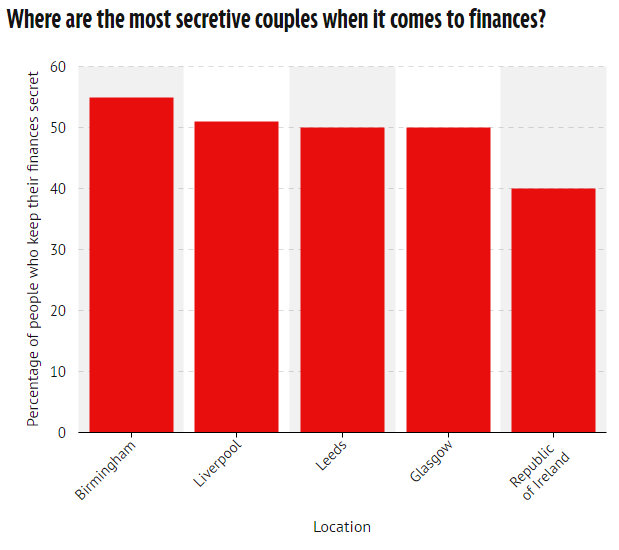
Top of the secretive list were people from Birmingham, with just under 55 per cent confessing to keeping their financial affairs ‘top secret’.

This was closely followed by Liverpudlians, with 51 per cent, and people from Leeds and Glasgow came in joint 3rd place, with 50 per cent saying they didn’t share financial information with partners.

Couples in the Republic of Ireland were the most honest about their finances, with only 40 per cent keeping their finances secret.

secretive couples

The poll also found that 35 per cent didn’t like discussing pensions with their partner – and 30 per cent said they even kept a health problem secret from their loved one.

Jamie Smith-Thompson, managing director at Portafina, said: “It’s not unusual for friends or colleagues to talk about money when things get tight before payday, but we wanted to know just how far these conversations go and how much we share.

“We were surprised to find that over half of those in relationships don’t discuss details such as salary, debts and savings with their partner, with debts being at the bottom of the sharing list.

“While some people see this as a way of protecting themselves in the future, the benefits of sharing important financial details and knowing about potential pressure points – such as debts or changes to retirement planning – should not be underestimated.

“More openness and communication in relationships can really help people create the future lifestyle they want.”


Curated by Timothy
Original Article